Sunday, December 13, 2015

Old Friends, New Friends . . .

December brings a lot of things, but one of those things this year is the end of our Amsterdam trip. Cue the rush to do everything that we’ve been putting off, and to re-do a few of the things that left that kind of impression on us.

One of those new stops was the Museum Willet-Holthuysen, former residence of Louisa Wilet-Holthuysen who left her home, furnishings, and art collection to the city when she died in 1895, so long as the canal house became a public museum. In some ways this was a lot like the Van Loom House—Louisa and her husband, Abraham, lived lavish lifestyles in the nineteenth century, and we caught glimpses of this in the Ladies’ Salon, Ballroom, and Garden Room.


Maybe we’re a bit more critical towards museums at this point in our stay, who can say? All I know is neither of the original owners had to actually work during their lifetimes, instead relying on their family fortunes to entertain guests and collect art. All I could think was that if, in 150 years, people visit Paris Hilton’s Beverly Hills mansion to get a taste of 2015, it might be just as authentic. The other thing is that despite Willet-Holthuysen’s fairly clear bequest, the house actually underwent a number of changes to get to the display it is now, which means a lot of negotiation between what was left and what was ultimately presented to the visitors. Things that would have been especially interesting to see, like the servant’s quarters, were essentially disregarded, and displays were reconstructed based on photographs or general styles from the period.

Sinterklaas gave us, amongst other things, tickets for an hour long canal cruise by Holland International Canal Cruises—we had seen the canals in the height of autumn, and so an overcast day on the edge of winter, after a cappuccino at a nearby café, made a nice complement (especially since this time the boat was enclosed and heated!).


I’ve spoken about the mesmerizing, concentric rings of the Dutch canals a couple times before (or at least meant to), but without seeing a picture it’s hard to get a mental image. That’s literally how the centre of Amsterdam is laid out though, along these rings of canals, with narrow canal houses lining the edges. Everywhere you turn in this city, you’re on a different waterway.


Which means that the canals are a perfectly legitimate way of getting around Amsterdam. We started at Centraal Station and took a leisurely route towards the Amstel River, making an arc back toward the centre of the city and then into the IJ—arguably a lake, but considered to be a wide river serving as a waterfront for Amsterdam. By the time we were finished, the Christmas lights in the heart of the city were coming alive.


On Monday evening, we finally made the connection with a family in Badhoevedorp, a somewhat-complicated-but-not-too-far-out-of-the-way spot where we had been invited for a meal that was rescheduled a number of times. Given that dinner is usually a private, family affair, the chance to be a part of that routine was very special to us.

The Arieses are an absolutely lovely family—Karin and Paul warmly welcomed us into their home, introducing us to their three equally lovely children, ranging from ages 9 to 3. The children have not yet started learning English in school, and so much of the conversation (especially focused around Sinterklaas, who had visited them in Delft a few nights earlier) was translated by one of the parents. We had hearty servings of a sausage and sauerkraut dish, with a fresh pie out of the oven topped with cream.

In between bites, we learned that Karin was an anesthesiologist, and Paul is a lecturer in Museum Studies—in typical Dutch fashion, however, both were very modest about what would be fairly prestigious careers in North America. After the meal, the family sang a song together—the same routine was followed at Pieter and Eveliene’s a few nights earlier, and it’s a nice touch.

Ruben, the oldest child, played a game of chess (read: I got destroyed in a game of chess), while his slightly younger sister Sarah showed Kayla her new children’s atlas of the Netherlands, a gift from Sinterklaas that she had been eager to teach Kayla about. The coffee was poured, and Karin and Paul rejoined us for a full family game of “Set”, a popular card game over here where you look for sets in groups of cards. For us newbie Canadians, the rules were a bit tricky at first, but Kayla downloaded the iPhone app as soon as we got home, so hopefully next time we’ll be a bit more competitive!

A couple of observations: Ruben was really good at the game, and even though he won every round, he easily could have won by more. However, his mother told him in Dutch to let us have a chance (because we were slower recognizing the sets), and he had no trouble backing off. He even made me a paper star, which he gave to me before he went to bed.


Second, the only television we noticed was a small one, and at no point was anyone transfixed by a cellphone screen. Family time here actually means family time, and maybe that has something to do with why Dutch people seem so well-mannered and genuinely happy.

All told, it was a very refreshing night out for us, well worth the minor hassle in getting the combination of train, metro, and bus.    

Come Friday afternoon, we got an early tram to Museumplein and spent a few hours in the Stedelijk Museum. Amsterdam’s modern and contemporary art gallery houses a weird and wonderful collection—although the last time we visited it, we were led around a series of empty rooms, getting asked questions about how we perceived progress, so suffice it to say we were at least a little bit nervous about walking into a room without knowing what was supposed to be on display.

Kayla is really into the CoBrA art movement, and so their blend of children’s art and folk styles (which, by the way, when it debuted at the Stedelijk back in 1949, was totally rejected by contemporary audiences) was a definite stop.


A couple of other pieces that I enjoyed, for different reasons. Charley Toorop’s “Recumbent Head of Medusa” from 1938, the style returning to realism imbued with symbolism:


This collection of tetrahedrons, with a cool blend of colour palettes:


Or this 1890 Anna Boch painting of a “Woman in Landscape,” which is kind of remarkable for all the simple brushstrokes that make the whole composition. As per the whole point of art galleries, you really need to see it on the actual canvas, but since most people reading this aren’t in Amsterdam, this will have to suffice:


And, of course, it’s nice to wander through the scattered collection of Van Goghs, Picassos, and Cézannes, if only to recognize the names.

It would have been wishing too much to have come and gone without seeing anything truly weird that looks like it was thrown together at the last minute, the biggest inside joke of the art gallery world, mocking the pseudo-intellectual interpretations some of the hoity-toity visitors manage to come up with and repeat without a trace of irony in their voices. Good for them, I guess.


After the Stediljk, Kayla went with a few friends to the Van Gogh Museum, and I went off to the Rijksmuseum, for one last sojourn in that mighty Dutch artistic palace.


The sprawling collection of art and history is too much to see in one day, but this was my third visit, and I think I’ve done it justice now. I saw a few new things, like the library and a blend of painting and sculpture that was uncannily reminiscent of moose quarters hanging in the shed, but mostly it was revisiting the stuff that I liked from previous visits.


For reasons that I don’t quite get, Barend Cornelis Koekkoek’s “Winter Landscape” from the 1830s remains my absolute favourite piece at the Rijksmuseum. It’s fairly unremarkable, except that it’s a winter day that I can smell, if that makes any sense. He got the glint of sun on the snow right, and the way the dirt shows through the snow on the well-worn tracks.


I’ll definitely miss some of the decidedly Dutch scenes, from “The Singel Bridge at the Paleisstraat” depicting a winter day on the Amsterdam canals (check out how the woman in the foreground is almost walking out of the canvas) to “A Windmill on a Polder Waterway.” Maybe for the same reason that I like the “Winter Landscape”—because I recognize the feelings and atmosphere of the places, even if the actual surroundings are imagined.


Just as dusk was settling in, large glass panes in the lobby of the Rijksmuseum were suddenly illuminated, as if by magic—they looked pretty ordinary if you looked directly up, but take a few steps back . . .


Four months isn’t enough time to grow overly attached to anything, but it is enough time to develop a connection and find familiarity and routine. The Netherlands has that kind of hold on me now—we know people, we like certain food, we know our way around. It’s always a bit sad, leaving something that you’re just getting used to, a far cry from that first day in Uilenstede when I flooded the bathroom and couldn’t imagine ever getting comfortable. But how lucky, to have all these memories to bring back—some of them literally reduced to pieces of art that trigger all the other memories and associations of a truly special place.

After the museum, I reconvened with Kayla, Mary, and Christie, and the four of us walked along the canals of Amsterdam, guided by the illuminated displays of the Amsterdam Light Festival, a public exhibition throughout the city of different light fixtures. Some blink, some are interactive, some are in special shapes—mostly, it’s just a chance to wander the city at night, taking in the festive glow.


We went back to Mary’s afterwards, where we opened a bottle of wine and a bag of chips before a delicious meal of carbonara, joined by half a dozen other young people. I wish we’d made the connection with this crowd earlier in our time here—we’ve been friends for a month or two, and even that limited amount of time has been really special. I guess it’s a case of better late than never.

And, of course, when you leave a place that you feel a connection to, part of the “missing” has nothing to do with the physical location, but with the people who you met there and shared an experience with. Maybe it would have been nicer to have met our Amsterdam friends in August, but imagine if we hadn’t made these connections at all.

Not even all of the paintings in the Rijksmuseum would have been much of a substitute for that.

Cheers,
rb

Saturday, December 05, 2015

Gifts of the Season

There’s something to be said for Dutch hospitality.

We’ve relied on it quite a bit this Fall, if we’re being honest. From the many times we asked for directions (in English), to our first few days when we had no idea about grocery store etiquette (and the cashier gladly weighed our bananas and printed the required sticker despite having a line full of customers), to the more meaningful invitations to spend time with Dutch people (more to follow), we’ve truly been astounded.

Newfoundlanders are supposedly well known for their hospitality and friendliness. And several Dutch folks have told us that the Dutch are known for being direct. Our experience has been that the Dutch are more like Newfoundlanders than we could possibly have imagined. Sure, they’re a direct folk and will tell you like it isbut honestly, that’s a trait we Newfies have in abundance. 


Anyway, we’ve written about the great experiences we’ve had this term joining the ISMA’s monthly meeting in Amsterdam. On our first night, we met Pieter and Eveliene de Boer, a wonderfully friendly and kind Dutch couple who have volunteered with ISMA for several years. We were struck by their openness and generosity; they were happy to teach us about Dutch traditions and customs but equally interested in our own lives and interests. Ryan was very touched, for example, when Eveliene—who we had seen a month before—remembered he had run in the Amsterdam Marathon and thought to ask how it went the next time we saw her. That evening also celebrating ISMA’s American Thanksgiving with the eclectic group of International students were Pascal and Pim, Eveliene and Pieter’s children. Pim impressed the group with a beautiful cello performance, whilst Pascal certainly impressed me with his skills playing “Head Soccer,” a tablet game he delighted in sharing with me.

Being that Ryan and I are interested in traditions and customs, we were really intrigued by the Dutch Sinterklaas holiday on December 5th. Sinterklaas, as we’ve come to learn, is the Dutch Santa, though I suppose Santa is actually the American Sinterklaas, as the figures are based on the historical St. Nicholas. Clad in a red hat and long white beard (though looking much more like a religious figure than jolly ol’ Santa), Ryan and I participated in the welcome celebration this year at Dam Square, the he arrived in the Netherlands from Spain. 


Imagine our delight when Eveliene and Pieter invited us to celebrate the tradition with their family! We gladly accepted their generous offer, as the opportunity to share in such a nuanced and familial tradition was something both of us recognized to be very valuable and special.

Amidst final papers and our first attempts at packing, it was a welcome break for us to choose presents for each of the family members.


Pieter and Pascal picked us up from our apartment at Uilenstede and we arrived at the de Boer household excited and in anticipation of this special family tradition. We first ate dinner together—Ryan’s favourite, lasagna—and then took tea to the family’s living room. Within minutes, the doorbell rang and, what do you know, when we opened the door, two large sacks filled with presents were there! Together the boys dragged them into the living room and Pascal, who had quickly become Sinterklaas, began passing them out as we munched on kruidnoten, bite-sized Dutch cookies spiced with cinnamon or chocolate and making a popular festive treat.


Christmas traditions at home are equally as ritualized as they are here. Stepping into another family’s traditions is an intimate invitation and look at their way of life and a special introduction to their values. In the Carroll household, Christmas morning was filled with chaos and excitement. Especially when Jenny, Nikki, and I were younger, we’d wake up as early as we could and have Mom and Dad out of bed shortly after 6:00 am. As an adult, I marvel at their willingness to get up so early (especially considering Mom likely didn’t get to bed until well past midnight and was already up before us to put the turkey on!). Anyway, I can only imagine what an outsider would have felt to be in that old living room watching three excited little girls ripping open and marveling at each present. Luckily (depending on your interpretation!), the Carroll family has videotaped their Christmas morning since probably 1995 and it’s now become a tradition to re-watch these videos together and laugh at the silly things we did and said. Nikki, the youngest sister, was easily the most generous—one of my favourite moments is when she expresses nothing but pure delight upon unwrapping a chocolate bar, and proudly presenting it to Dad, the cameraman, she says “A bar! A bar! I’ll share he with you!”

Anyway, these images were in my mind as we took part in the de Boer’s special family tradition. It was so lovely to see how delighted and appreciative Pim and Pascal were of each individual present. The whole party watches each family member open their present and the receiver, upon inspecting the gift, exclaims: “Thank you, Saint Nicholas!” Ryan and I were so thrilled and honestly surprised by our presents; we had expected one parcel each but could not believe how spoiled we were! 


A couple of those gifts happened to be very typical Dutch presents, like large chocolate letters in the shape the first letter of your name.


We were also included in the more poetic tradition associated with the Sinterklaas festivities: each family member receives a poem from Sinterklaas that humorously recounts that person’s various exploits throughout the year and hints at the present they will receive. 


It was such great fun and my face was nearly hurting by the end from all the smiles and laughs. Pascal in particular is quite the entertainer and kept us all laughing.


At the end of the evening, both of us agreed that this was a definite highlight of our time in the Netherlands. We could not have dreamed in August just how much it would mean to us to be able to participate in such a lovely and special tradition, and it made us reflective on our own family Christmas traditions which are quickly approaching.  

xo
kc

Monday, November 30, 2015

Danish Legends

The first thing I said on Sunday morning was that I should have brought my sunglasses. The Copenhagen sky decided to help by pouring rain as we made our way to the station to catch the next train to Lejre, a village about 50 km west.

The small settlement is a relatively unobtrusive blip on the Danish countryside today, but it was once the capital of an Iron Age kingdom and the real-world counterpart to Heorot, the famous mead-hall in Beowulf. It’s because of the extensive historical dramas that played out on these simple fields that this area is described as the “land of legends.”

More particularly, an open-air museum not far from the train platform, Sagnlandet Lejre, boasts the English name Land of Legends. This is an archeological site, but it’s also an immersive, interactive experience, described as “experimental archeology” because of the way in which re-enactors use historically accurate techniques to heat reconstructed buildings, weave costumes, and construct pottery. The Land of Legends, in the space of about 100 acres, brings together a Stone Age campsite (circa 5000 BC), Iron Age settlements (around 200 BC), a Viking village (900 AD), and an eighteenth century village (positioned as far away from these heathen influences as possible, of course).


During the summer months, families can actually sign up to live in these unique places, dressing in the historical costumes and living life as we think they might have done, hundreds (or in some cases, thousands) of years ago. Not surprisingly, the Land of Legends was much more sparsely populated at the end of November, but the whole area was open to the public for free, as part of the Christmas season (it’s closed for most of the fall season).


A larger version of the map is available here

An empty bus was waiting at the train station, and the friendly, middle-aged driver accepted our train tickets from Copenhagen, even though we’re pretty sure he was just glad for the company. The drive through the village, sleety snow in the ditches and marshes spread out across the low-lying fields, felt a bit too much like the drive to Eel Marsh House in the Woman in Black. We were more interested in different kind of ghosts though. 


The absence of a full crew of re-enactors and tourists actually afforded us a really unique perspective of the Land of Legends, starting at the Viking village. We were able to walk through the reconstructed buildings at our leisure and across the fields, breathing in the fresh, albeit brisk, Danish air. The rain held off while we were in Lejre, though every other step was through the mud.


Things got even more deserted as we moved to the Iron Age village, where we felt wonderfully isolated in time and space.


Just past the Iron Age village, a path through the woods supposedly leads to a Sacrificial Bog—remember the Bog Bodies in Copenhagen? Some of them likely came from ceremonial sites like this one, but the bushwhacking ended up being too tangly and off the beaten track that we were convinced we were headed to our own sacrificial pool of muck and couldn’t count on getting out in the end.


Meanwhile, a log bridge connects the Stone Age campsite to the rest of the site—a very low-lying bridge at this time of year, and you can imagine what happened as soon as we put our weight on the plank. All the crews of Vikings and Iron Age hunted never had adventures the likes of the two of us trying to get across that bridge and keep our shoes in decent condition.


On a piece of higher ground, overlooking a sizable, beautifully desolate landscape, there were boulders arranged in the pattern of a ship—a Viking Age Stone Ship, a massive burial monument (no bodies here, although this reconstruction was, like everything else at the Land of Legends, assembled using ancient techniques, and is a replica of a Stone Ship located about 2 km away that had been cleared by the landowner in 1921).


Leaving the Vikings and prehistoric folks behind, we entered an eighteenth-century village, where re-enactors kept the low-lying houses warm on a cold afternoon by constantly tending a fire in the kitchen, offering visitors a seat in the cozy wood heat to shake off the chill—and a steaming hot beer, if that suits your tastes.


We passed through a number of workshops on our way through the village, including a textile workshop where period costumes were constructed using large looms, and a pottery where jugs and vases were created, for sale at the gift shop.


On a hillside, the grunts and groans of wild pigs filled the ears. We were walking side-by-side with a costumed peasant now, so Kayla asked what happened to Piglet and her friends over the winter. Here we were, in a world that literally had a portion of bog designated as a Sacrificial Bog, but the nonchalance of being told most would be slaughtered still somehow caught us off guard.


The Land of Legends is a strange place to have stumbled upon, and a really cool place for exploring in the off-season. Of course, the settlements arranged in a neat row are hundreds of years apart, but the park still gives a sampling of Danish history over a long trajectory.

Our bus driver friend was parked by the entrance gate, almost as if he were waiting for us again—he had one more passenger this time, the Pig-Slaughtering-Peasant. When we tried to buy our tickets, we found out that his dispenser only accepted cash—which of course we had none of, so we had to go back through the gift shop and take a few kroner out. As we left though, we thought we heard the bus driver yell something at us, but decided we were hearing things.

With a few coins in our pocket, we came back to the parking lot, only to hear the bus coming to life—he said he’s wait for us, right? We jumped on-board, but as we tried to hand him the money he simply yelled: “I have to go!”

Turns out the train to Copenhagen only passes through Lejre once an hour. Turns out said train was coming in about five minutes, and so the bus sped across the narrow roadways to somehow make the journey in four. As we jumped off the bus at the platform and tried to hang him the coins, he refused them—which probably explained what he yelled out to us, and says something about the hospitality of the Danish people.

Let’s just ignore the fact that the bus could have abided by the speed limit if we hadn’t gone back for those coins in the first place. Pig-Slaughterer jumped off with us to point us in the right direction, and the unlikely team of three ran across the platform, found the ticket machine, and punched in our destination as the lights of an oncoming train appeared at the edge of the tracks. I couldn’t have written a more down-to-the-wire ending if I tried—the screen read “Printing” (come on, come on, come on) just as the brakes of the train squealed and the doors hissed open, and we waited until we were seated before catching our breaths.

After another long day, we were both exhausted as we settled in for the half hour trip back to Copenhagen, calling ourselves pretty lucky.


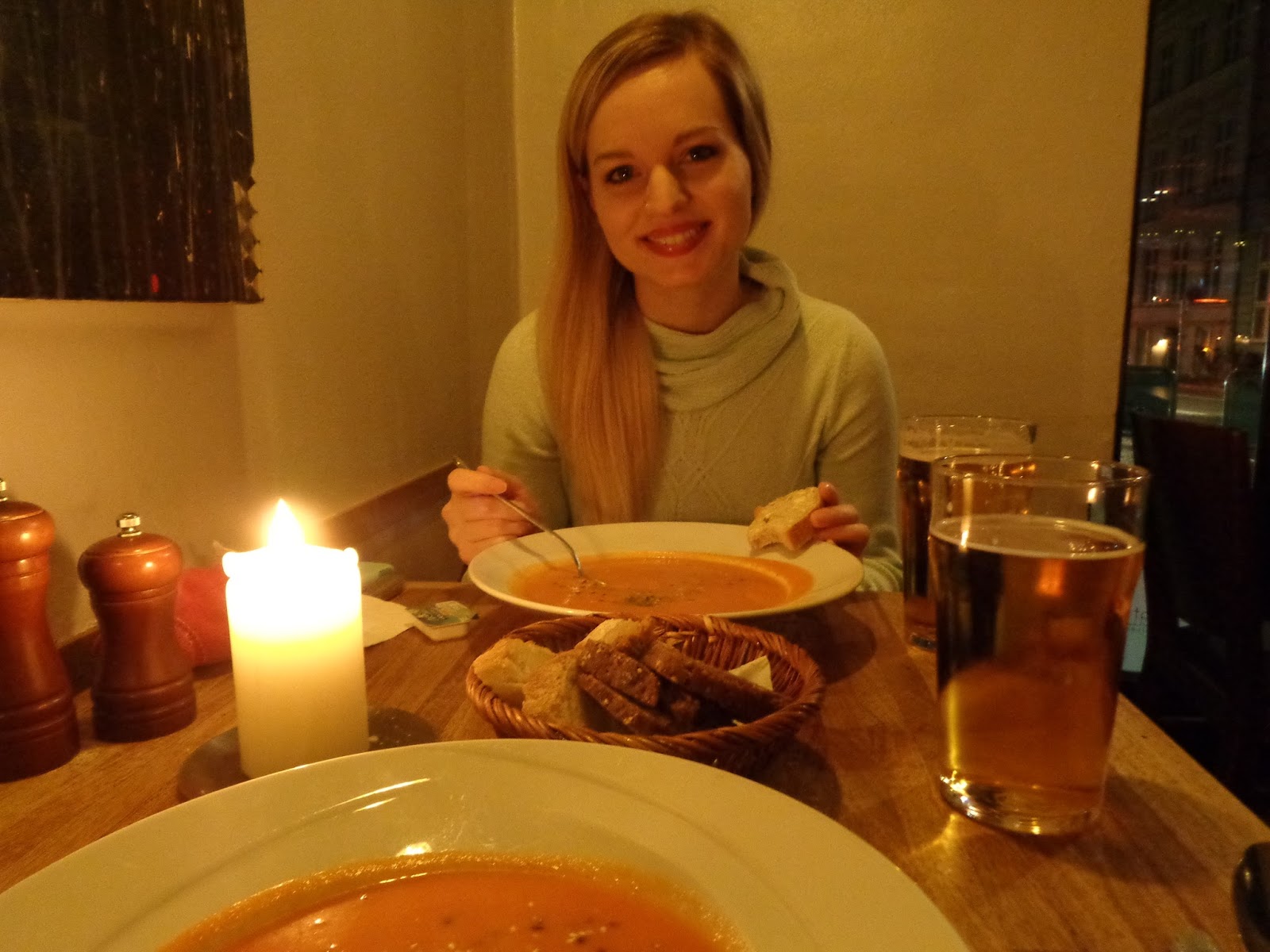
We found a café that was essentially a less-smoky version of the house in the Land of Legends—a close, cozy atmosphere with hot, creamy soup, a far cry from the hot dogs and croissants we’d been accustomed to. Oh, and the beer was cold here.


When we got back to Trine’s, our host had left a note for us that she was gone for the night—I realize that when you sign up for Airbnb you have to go through a verification process, and the whole system works on user ratings and feedback, but it’s still amazing (or insane?) that someone would trust another person they’ve just met with the complete run of their house. I thought a bit about some of my earlier experiences Couchsurfing—this definitely has some similarities, especially when it comes to trust and interaction, but Airbnb sets up definite level of distance with the host (or at least have a greater potential to do so). We didn’t speak a whole lot to Trine during our two-night stay, whereas that’s kind of the whole point of Couchsurfing—I guess privacy is part of what you pay for, for good or for bad.

Anyway, we didn’t go through her desk or steal all her tea. Again, for good or for bad.

After a windy, rainy night, the morning dawned overcast but dry. We hooked onto the metro line and got ready to leave Copenhagen in the early afternoon.


We still have two and a half weeks left in Europe, but that time will quickly slip by. The turbulent flight from Copenhagen to Amsterdam was our last flight together for the foreseeable future, and the wall of European city maps is full for now—instead, we have term papers and final assignments to fill up the remaining time, along with some decidedly Dutch Christmas festivities.


Shouldn’t be too hard to have a bit of fun in the time we’ve got left, but it will be nice to be on the other side of the Atlantic again after all.

Cheers,
rb