One of the things that has always been notoriously unclear
to me (one of a long,
long list that
includes hibernation and fireworks) is
Vatican City. Yes, it’s the
ecclesiastical state ruled by the Bishop of Rome, otherwise known as the Pope,
and it’s the smallest independent state in the world, wholly contained within
Rome. But what does that really mean?
Alright, let’s start at the beginning. As in the Gospel of
Matthew, first book of the New Testament.
Simon Peter was one of the disciples
of Jesus, and in Matthew 16:18, Jesus says to him “And I say also unto thee,
that thou art Peter and upon this rock I will build my church; and the gates of
hell shall not prevail against it.” Roman Catholics read this line as Jesus’
way of ordaining Peter, giving us the first Pope. So now we have the papacy,
around about the year 30 AD.
Flash forward to 313 AD, and the Roman Emperor Constantine,
by enacting the
Edict of Milan, made Christianity a legal religion in the Roman
Empire. Prior to that point, the Popes and their followers were the targets of
persecution—far from the position they occupy now. Add a few more hundred years
for Catholicism to build momentum along the Italian Peninsula, and we start
seeing the papacy acquiring territory—a lot of it. The
Papal States emerged as
a sovereign state, with the Pope as the head of state.

Remember that back in those earlier days, the Italy we know
today was a lot more fragmented. So even though a state controlled by the Catholic
Church might have been a bit unique, it wasn’t a jarring contradiction in its
scope or economy or anything else—Popes were as involved in military strategy
and signing treaties as they were with the Eucharist. But in the 1800s, we saw
a concerted move towards Italian Reunification—remember
Victor Emmanuel II?
Well, one thing stood in his way in 1870, and it wasn’t some malevolent enemy
(depending on who you asked, anyway)—it was Pope Pius IX.
The
Capture of Rome on September 20, 1870 ended the Papal
States’ hold on Rome. The unification was complete, save for one little slice:
the
Apostolic Palace, official residence of the Pope. That is, of course,
within the boundaries of what we now know as the Vatican City. In a show of
unrivaled stubbornness, a total of five Popes, spanning 59 years, continued to
reside within the Apostolic Palace, refusing to leave the Vatican or even to
appear on the famous balcony, as if this would be a sign of their acceptance to
Italian authority. This was a big issue, and it clearly wasn’t going away—so,
in 1929, the
Lateran Treaty created the sovereign state of the Vatican City,
and restored some semblance of territorial power to the Holy See.
Alright, now that we’ve made it this far, what does that
really mean? The Vatican is a separate state, fair enough, but you don’t need a
passport to enter it. It’s not a member of the United Nations (but it does have
permanent observer status), and it’s pretty small to actually be considered a city, let alone a country, isn’t it? Part of the problem, I think, is that we have a conception
of a country as having things like airports and shopping malls and towns that
you need a car to get to, but that’s not the
legal definition of a state.
A wall runs around the Vatican, containing St. Peter’s
Square and the Sistine Chapel and the Vatican Post, making it a necessary place
to visit within the boundaries of Rome, whether you’re Catholic or not. There’s
literally no other spot on earth quite like it.
So, that’s where I found myself on Friday morning, walking
across the Tiber before the rush of visitors flocked to the famous churches.
St. Peter’s Square is instantly recognizable: a huge oval, with massive
colonnades topped by statues wrapping around the cobbled square and the obelisk
in the centre. At the top of the oval, there is a long straight portion, today
covered in plastic chairs because I just missed a
Papal Audience with Pope Francis on
Wednesday. And then, at the front of that section, stands St. Peter’s Basilica.


There are a lot of famous churches in the world. I won’t
call St. Peter’s the most famous, but
it’s definitely a mecca for anyone with an interest in these otherworldly
beautiful structures. To get into the Basilica, you stand in a lineup that
passes along the curve of the colonnade, going through a metal detector before
you can enter the sanctuary. At this time in the morning, the lineup was
short—I came back later in the afternoon and found it wrapping around most of
St. Peter’s Square, adding credence to the oft-supplied advice to get there
early.
Naturally, St. Peter’s is stunning from the inside. The dome
alone, designed by Michelangelo and rising 130 m off the ground, cranes your
neck up as though searching for God in the heights.
The rest of the nave stretches on, amazingly adorned and
immense in scale. It’s kind of exactly what you’d hope it would be—and it
reinforces this understanding I get, every time I walk into one of these sacred
places. Especially a few hundred years ago, people didn’t have much explanation
for the things that happened around them. If you stepped into one of these
churches, built in a way that defies your conception of what was possible, all
in the name of this one eternal deity and the promise of Paradise, you’d be a
bit of a lunatic to be a heretic, wouldn’t you?
Fittingly, St. Peter’s also hosts the tomb of St. Peter, as
well as the tomb of Pope John Paul II. Actually, there are 91 Popes resting
here, but these were two who I immediately recognized as significant.
Judging by the relatively short line in St. Peter’s Square,
and the short line the day before at the Colosseum, I decided to save a few
euro and not reserve a specific ticket for the Vatican Museums, but rather to
wait in the lineup for general admission. That was a mistake—the lineup (which
starts outside the walls of the Vatican) stretched past a bend in the wall, so
I couldn’t even tell how far from the front I was.
Fortunately, even a longer-than-expected wait didn’t take
forever, and I found myself inside the Museums in time for a pasta lunch at the
cafeteria before moving through the displays.
Contrary to what you’d think, the Vatican Museums isn’t a
museum on the Vatican. Pope Julius II
founded the museums in the sixteenth century, and it’s a sprawling collection
of sculptures and artwork that the various Popes have collected over the
centuries. The entirety of the collection is presented in 54 different
galleries, and the only way to access them is in a linear fashion—there’s no
cutting corners on this one, you have to walk through them all.
Which generally isn’t an issue, when there’s a collection
like this. But when the Sistine Chapel is the end goal, it gets a bit harder to
take your time. Along the way, there are more than a few highlights, ranging
from the depths of antiquity to the Renaissance, on to modern Catholic imagery.
You’ve probably never seen quilts this intricate—or violent,
come to think of it.
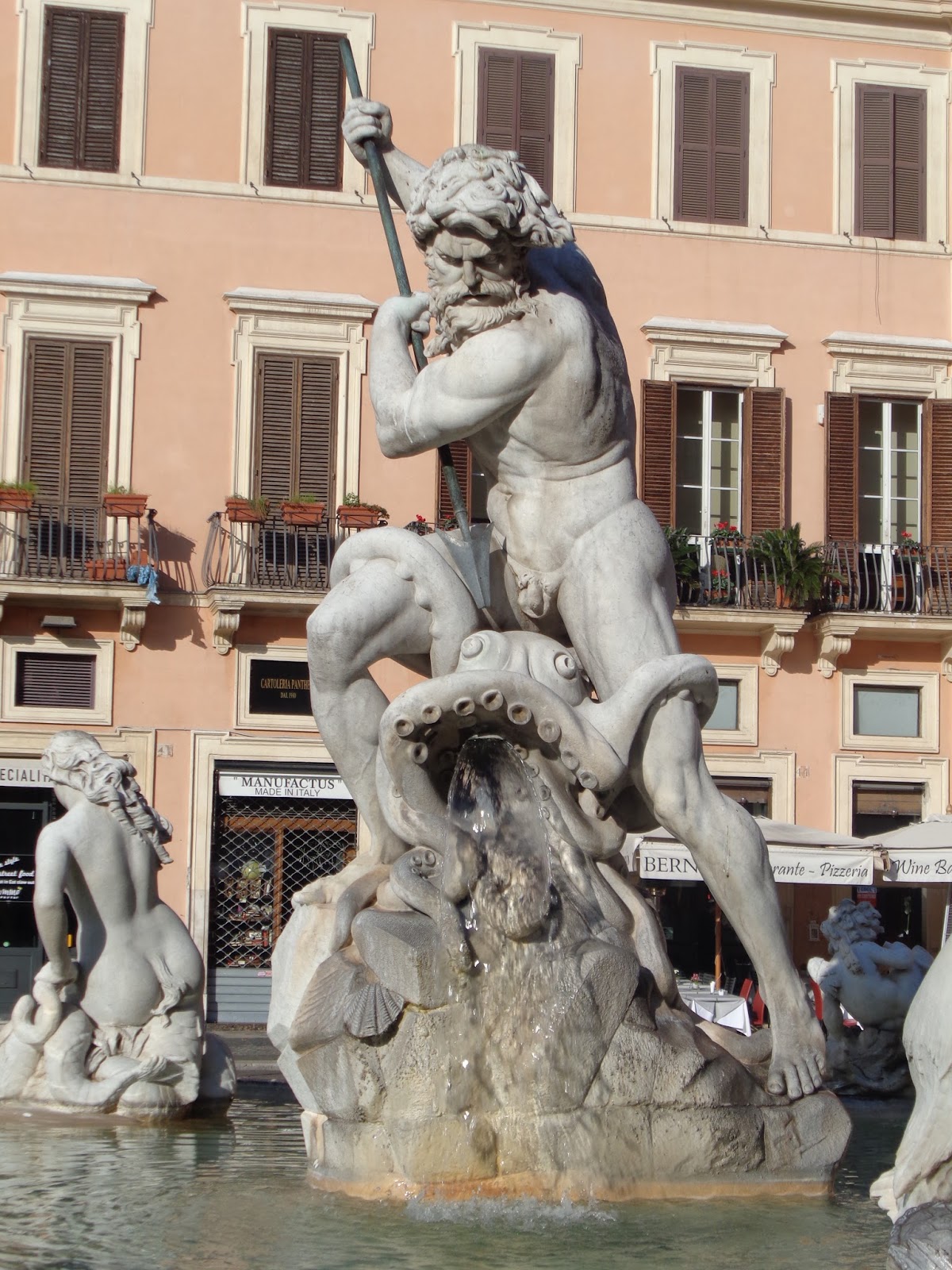
Amongst the things I learned in Rome is that you probably
shouldn’t get on the wrong side of a nude dude.
One really notable stop, almost at the end of the Vatican
Museums, are the four
Raphael Rooms, made up of frescoes by the famous
Renaissance-painter-turned-ninja-turtle. A fresco is painted right on the fresh
plaster of the wall or ceiling, and these murals create a visual experience
that’s simply more than the eye can take in. I guess the sense of being a small
observer in a larger scene is part of their charm. Besides for the fact that
these rooms are representative of the High Renaissance in Rome, one fresco in
particular—“The School of Athens,” depicting a slew of Greek philosophers doing
what they do at the Ancient Agora—stood out as being instantly recognizable,
but also grander than any other representations I’ve ever seen.


Then, at last, comes the
Sistine Chapel. It’s here that the
Papal conclave meets to choose a new Pope, but the site is most famous, of
course, for its ceiling. Now, I can be a bit culturally ignorant at times, no
matter how hard I try not to look it. I really thought that “The Creation of
Adam,” the fresco where God is reaching out a hand to the newly created Adam,
was the ceiling. Like, I thought you looked up and there was a gigantic scene
of the creation of humanity, that’s it, and that was why this was so
awe-inspiring.
So obviously I was a bit thrown when I saw this. In a good
way.
The ceiling of the Sistine Chapel, painted by Michelangelo
between 1508 and 1512, covers the gamut of Biblical imagery, high above your
head so that the only thing to do is tilt your head until your neck aches,
trying to take everything in and realizing there’s just too much of it. Trying
to imagine an artist, suspended high above the chapel, creating these scenes
that were destined to survive for 500 years.
It doesn’t stop at the ceiling, either. In a different tone
(Michelangelo was considerably older in 1536 when he started this fresco, and
the political climate in Rome was different), “The Last Judgment” on the
sanctuary wall depicts, in equally scale and complexity, the final days of
humanity. In effect, the art of the Sistine Chapel encompasses everything we’ve
ever done and ever will do—it’s little wonder it’s a crowning achievement of
Renaissance art, and human creative achievement.

I try to have a few rules when I’m at an art gallery—and I
break them from time to time, because I’m fallible as they come. But they’re
pretty straightforward rules: first off, look
at the things on the wall. I like actually looking at the brushstrokes and
texture, because that’s the stuff a digital replication can’t capture very well.
Next off, is the painting famous? If so, only take a picture of it to show
something that a million other pictures of it don’t—like the size of it in a
room, or the frame, or some different perspective. If the painting isn’t famous
(so it might be more difficult to find again if you were to look it up), maybe
then it’s alright to take a picture, especially if you like it.
But in the Sistine Chapel, I don’t think there’s any excuse.
It’s a clear rule when you enter: no photography. There are folks in suits
standing around, literally forcing people to delete any pictures they take, and
every five minutes or so they come on a loudspeaker and say: “No photographs!”
And yet, in this crowd of people, there are dozens who are convinced that that
rule doesn’t apply to them. And here’s the kicker: any picture you take on your
iPhone is going to suck. That’s not an insult to your ability to take a
picture, it’s just because you’re taking a picture of a massively detailed
ceiling with a tiny lens on your phone. Your pictures are going to be so much
worse than the incredibly iconic shots of the Sistine Chapel that already
exist—they’re so iconic, they’re probably the reason you showed up here today
in the first place. Related to that, literally anyone can find a picture the likes of which you’re taking, but you
know what only a small chunk of people ever do? Stand in the incredibly overwhelming midst of the Sistine Chapel and
look at a piece of art that boggles your mind and grabs hold of your senses.
But take your contraband picture and get more satisfaction
out of a few friends clicking “like” on Facebook than actually experiencing
something in your life. Your choice. For me, despite the crowd control and the noise, this was a very special place. I don’t consider myself the holder of any particularly strong religious convictions, but then again that’s not a requirement to feeling a chill in the presence of such vivid, spiritual art.
Outside, the heat of an Italian afternoon was in full force,
and the gelato I bought had to be eaten quickly before it turned to soup in its
cone. It’s hard to top the kind of sensory experience I’d just had, so I
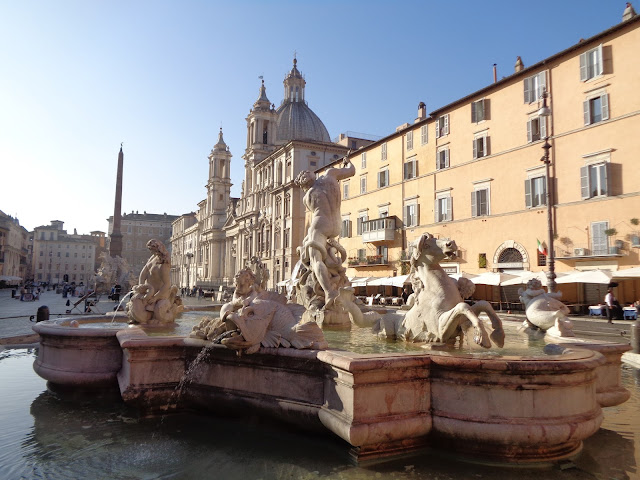
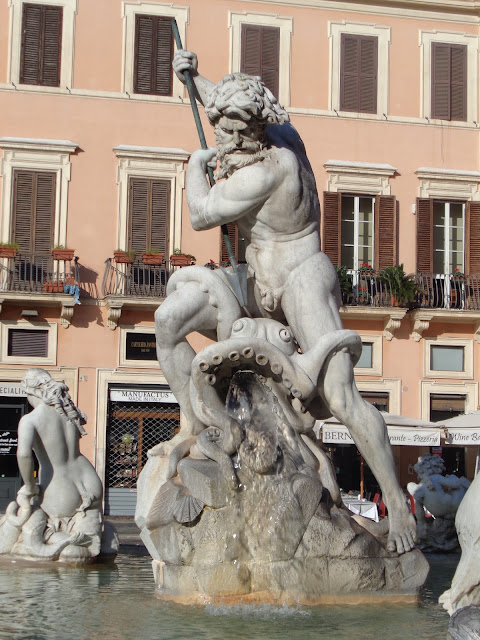
contented myself to spend the rest of the afternoon wandering around Rome,
finding the odd surprise around any given corner—a statue or obelisk here, a
fountain there. Rome is a city made for roaming, especially if you keep to the
pedestrian areas (I would not want to
have to drive a car in Rome—this is November, close to the low-point of the
tourist season, and still the roadways were reminiscent of Han Solo steering
the Millennium Falcon through the
Hoth asteroid field).


I spent my final day in Rome doing a little bit more of the
aimless wandering I’d come to enjoy in the Eternal City—there’s always
something new to look at or, more fitting, something very old to look at. Like the Theatre of Pompey—not much to see
now, just some ruins in an enclosed space on a busy city street, but this was
the very spot where Julius Ceasar was likely assassinated in 44 BC.
The ruins throughout Rome are popular spots for stray cats,
although to a considerably lesser degree than in Athens. At the Theatre of
Pompey though, in a little nook near to the rubble, is a cat sanctuary, where
the strays are given food and, should the right person stroll in through the
doors, a new home. Solo travel, despite being liberating, can be lonely at
times, but here at last I thanked all the Roman gods I could rhyme off that
Kayla didn’t come to Rome with me—it would have been a nuisance bringing a new
cat back to Amsterdam in our carry on luggage.
I also paid a visit to the
Baths of Caracalla, more out of the
way and less touristy, but still a sizable, ancient structure dating from 212
AD. In its heyday, this was a public bath that could have accommodated hundreds
in a number of different pools and exercise rooms, all exquisitely ornamented.
Outside the baths was a garden, perfect for strolling on a hot afternoon in the
beginning of November.
Likewise, the Circus Maximus, the public park where chariots
once sped, made for another nice afternoon walk.
As if the visit to St. Peter’s and the Sistine Chapel had
not satiated my appreciation for historic, grandiose churches, I sought out the
Sant’Ignazio Church. Being one of hundreds within Rome, this Catholic church,
dedicated to Jesuit founder Ignatius of Loyola, might seem an oddly specific
choice. Like the Sistine Chapel, the whole point was to look up.
Also like the Sistine Chapel, I doubt pictures do it. That’s
because, where a lofty fresco is concerned, depth is impossible to capture in a
single image. But, the ceiling of the nave, painted by Andrea Pozzo in the late
1600s, presents an illusion of the roof actually opening up the sky. There even
is a designated gold circle on the floor for the best place to stand and
look—if you move to the front of the altar, though, you see the ceiling as a
much flatter painting. If you walk along the length of the church with your
neck craned, you can actually see the painting open up to the heavens.


A wood plastic model of the “Temple of Christ the King”
rounded out the visit to this church—the work of a 70-year-old cabinet maker
who spent the final 28 years of his life making miniature versions of different
churches around the globe, all on the circumference of a much larger church. It
was actually a beautiful surprise find, not just because of how intricate it
was, but because of the way it embraced the different religions of the world
and unified them. According to the placard on the display, it was meant to
“constitute the cradle of the dialogue between religions, imagining the end of
all the wars to reach the Universal Peace.”


On that uplifting note, mind body and soul were more than a
bit exhausted, and I still had a long night ahead of me. The last shuttle bus
to the airport left Termini around midnight—meanwhile, my flight wasn’t until
6:00 in the morning. I could have set an alarm for 3:00 and gotten a cab . . .
or I could have used my laundry bag as a pillow, put sunglasses on to cut out
the glare from the overhead lights, and slept on the terminal floor of the
Fiumicino Airport.
Let’s just say I spent a lot of the last forty-eight hours
in Rome staring at a ceiling far overhead, living like a Spartan instead of a Roman.
The damp foggy morning of Amsterdam was a strange sight
after what felt like a long absence, but it also felt like the comforting
embrace of home. I don’t know where the autumn disappeared, but lights on shop
corners have started their holiday illumination, and the arrival of Sinterklass
from Spain is only a few days away (more on that soon).
These last two weeks have been nonstop—it’s been a real
thrill and a privilege, seeing so much in so short a timespan, but it starts to
wear on you. Right now, I can’t wait to spend the next few weeks cozy and
complacent here at our apartment, where the most exotic trips we have in store
for us are walking to the Jumbo to buy a bottle of wine and a bag of paprika
potato chips.
Cheers,
rb