Monday, December 14, 2015

Nuts About the Ballet

We had a chance, in our encounter with Sinterklaas, to experience a Dutch Christmas tradition. How about a more familiar Christmas tradition, but with a Dutch twist?

It was a couple of months ago that Kayla, innocuously enough, suggested that we go to the ballet while we’re in Europe. The Dutch National Ballet has been performing for over 50 years in Amsterdam, and has been known to produce some of the most notable ballets. We’ve both been to plenty of theatre performances, but this was definitely a first for us—and so, we booked two tickets for “The Nutcracker” as a seasonal treat to end our trip.


“The Nutcracker” occupies a strange place in our cultural understanding, I think. Most people know something about it, but it’s a much smaller group who can actually tell you very much about it. There’s a Nutcracker, a Mouse King, something about a Sugar Plum Fairy, and snippets of songs that you recognize as much from shopping mall soundtracks as from an orchestra pit. Still, “The Nutcracker” premiered in St. Petersburg in 1892, and since that time has grown to become a Christmas tradition, especially in North America—so much so that contemporary ballets earn some 40% of their annual revenue on this one performance.

Tchaikovsky composed the iconic score to “The Nutcracker,” with the story (the libretto, if we’re using the correct lingo) adapted from E.T.A. Hoffmann’s 1816 story “The Nutcracker and the Mouse King.” On a rainy Saturday night, we found ourselves at the sold-out Dutch National Opera & Ballet building, sipping a glass of wine before the bell signaled it was time to get seated.


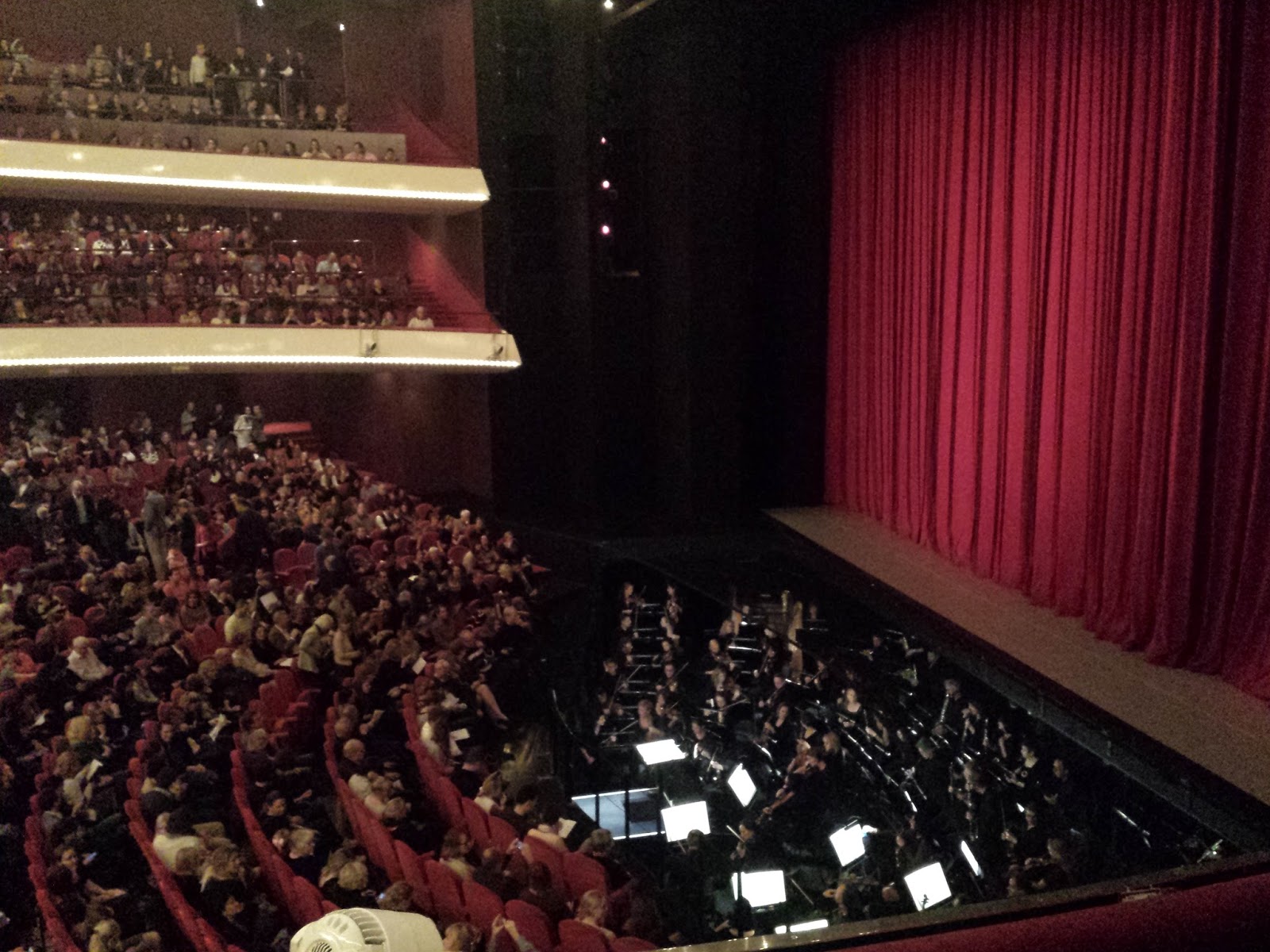
When we entered the wide-open theatre, we found our plush seats on the first balcony, just to the side of the stage and looking down into the orchestra, already assembled before the curtains went up.


Naturally, once the lights went down, any recording was off-limits. Let me lead you through the ballet though—and don’t worry, there were plenty of young families present, so this isn’t some pretentious, high-culture assemblage. Truth be told, for our first ballet, it was very accessible and enjoyable.


The scene opens on an Amsterdam canal at night—for the first act especially, the sets were incredible, with one wall devoted to a canal house (the door constantly opening to let visitors in, just in time for a Christmas party) and the mid-section of the stage looking like a frozen canal, full of skaters. Productions of the ballet around the world vary on a lot of the details (like the setting), but the Dutch touch was nice.

The only thing wrong about it was how gracefully the characters shook the light snow off their umbrellas upon entering the house. When I left Uilenstede with an umbrella that night, the wind whipped it beyond recognition as soon as we got out of the building, and it ended up as a crumpled mass in the garbage dumpster—ah, the magic of theatre!

Characters’ names vary as well—not that it really matters, given that there’s no dialogue in the entire piece, just the music. Generally though, the main children are named Clara and Fritz, and their godfather is Drosselmeyer, a toy-maker and magician (when he entered the party, he causes his umbrella to levitate). The entire party dances, and then Sinterklaas enters, giving gifts to the children.


After he leaves, one child was forgotten—Drosselmeyer sets up a projector and plays a love story of a young soldier and his princess, and when it ends there’s a nutcracker on the stage. Clara has a perfect gift, until Fritz decides he wants to play with it too, and suddenly the nutcracker has no head.

For large chunks of the show, there were a lot of people on the stage, and each person had a very specific role in the ballet. That meant that there was a lot to pay attention to at any given point, and it’s especially difficult when there’s no dialogue to give you clues about what ought to be the focus—the stage directors compensated for this by using spotlights to subtly direct your attention to the right places. Everything was very symmetrical too, in terms of the men and women dancers and how the pairings were ordered on the stage, often interweaving in perfect order. Meanwhile, the conductor was positioned with a view of both the pit and the stage, so that the music meshed perfectly with what was happening on stage.

During the party scene, which ended when the clock struck midnight and Clara got out of bed, there was a see-through veil covering the front of the stage—this was suddenly lifted, perhaps signaling the shift into the dream world, populated by the creepy minions of the Mouse King (himself wearing a very creepy fuzzy white mask with beady red eyes), and real-life toy soldiers led by the Nutcracker. Clara and Fritz were replaced here by older performers, capable of some of the more difficult routines—that said, the ballet made definite use of very young performers, and these got a special applause at the end of the production.


The first act ended with a decisive swordfight between the Mouse King and the Nutrcracker, with the second act playing out on a considerably sparser stage. It felt like the narrative wasn’t there as much, but the dancing was just as impressive, and what the stage lacked it made up for in its costumes—we were now in the Land of Sweets, en route to the Sugar Plum Fairy, and different regions of the world (oriental performers in beautiful silk, heavily costumed Russians) represented different sweets (tea and candy canes, in those two examples).

We figured espressos and wine over the intermission must have motivated the audience—whereas we sat in attentive silence in the first act, there was applause after every musical number in this act. Especially once the Sugar Plum Fairy made her arrival, dancing to the most iconic number of the entire ballet (and probably the most iconic use of the celesta in the entire vast world of music composition).


The dream world of the Nutcracker and the Sugar Plum Fairy eventually subsided, bringing us back into Clara’s bedroom, where she and Fritz rush to the door to bid Drosselmeyer good night as he heads out into the Amsterdam night along the snowy canal.   

All in all, a pretty decent introduction to ballet—throughout the performance, we recognized more than a few of the pieces, and even if the story deviated a bit from the typical source material (no gingerbread characters to be seen), it still felt familiar. It still felt like a magically warm Christmasy embrace.

Against the backdrop of a December night in Amsterdam, we caught the train back to Uilenstede, literally with visions of Sugar Plums dancing in our heads.

Cheers,
rb

Sunday, December 13, 2015

Old Friends, New Friends . . .

December brings a lot of things, but one of those things this year is the end of our Amsterdam trip. Cue the rush to do everything that we’ve been putting off, and to re-do a few of the things that left that kind of impression on us.

One of those new stops was the Museum Willet-Holthuysen, former residence of Louisa Wilet-Holthuysen who left her home, furnishings, and art collection to the city when she died in 1895, so long as the canal house became a public museum. In some ways this was a lot like the Van Loom House—Louisa and her husband, Abraham, lived lavish lifestyles in the nineteenth century, and we caught glimpses of this in the Ladies’ Salon, Ballroom, and Garden Room.


Maybe we’re a bit more critical towards museums at this point in our stay, who can say? All I know is neither of the original owners had to actually work during their lifetimes, instead relying on their family fortunes to entertain guests and collect art. All I could think was that if, in 150 years, people visit Paris Hilton’s Beverly Hills mansion to get a taste of 2015, it might be just as authentic. The other thing is that despite Willet-Holthuysen’s fairly clear bequest, the house actually underwent a number of changes to get to the display it is now, which means a lot of negotiation between what was left and what was ultimately presented to the visitors. Things that would have been especially interesting to see, like the servant’s quarters, were essentially disregarded, and displays were reconstructed based on photographs or general styles from the period.

Sinterklaas gave us, amongst other things, tickets for an hour long canal cruise by Holland International Canal Cruises—we had seen the canals in the height of autumn, and so an overcast day on the edge of winter, after a cappuccino at a nearby café, made a nice complement (especially since this time the boat was enclosed and heated!).


I’ve spoken about the mesmerizing, concentric rings of the Dutch canals a couple times before (or at least meant to), but without seeing a picture it’s hard to get a mental image. That’s literally how the centre of Amsterdam is laid out though, along these rings of canals, with narrow canal houses lining the edges. Everywhere you turn in this city, you’re on a different waterway.


Which means that the canals are a perfectly legitimate way of getting around Amsterdam. We started at Centraal Station and took a leisurely route towards the Amstel River, making an arc back toward the centre of the city and then into the IJ—arguably a lake, but considered to be a wide river serving as a waterfront for Amsterdam. By the time we were finished, the Christmas lights in the heart of the city were coming alive.


On Monday evening, we finally made the connection with a family in Badhoevedorp, a somewhat-complicated-but-not-too-far-out-of-the-way spot where we had been invited for a meal that was rescheduled a number of times. Given that dinner is usually a private, family affair, the chance to be a part of that routine was very special to us.

The Arieses are an absolutely lovely family—Karin and Paul warmly welcomed us into their home, introducing us to their three equally lovely children, ranging from ages 9 to 3. The children have not yet started learning English in school, and so much of the conversation (especially focused around Sinterklaas, who had visited them in Delft a few nights earlier) was translated by one of the parents. We had hearty servings of a sausage and sauerkraut dish, with a fresh pie out of the oven topped with cream.

In between bites, we learned that Karin was an anesthesiologist, and Paul is a lecturer in Museum Studies—in typical Dutch fashion, however, both were very modest about what would be fairly prestigious careers in North America. After the meal, the family sang a song together—the same routine was followed at Pieter and Eveliene’s a few nights earlier, and it’s a nice touch.

Ruben, the oldest child, played a game of chess (read: I got destroyed in a game of chess), while his slightly younger sister Sarah showed Kayla her new children’s atlas of the Netherlands, a gift from Sinterklaas that she had been eager to teach Kayla about. The coffee was poured, and Karin and Paul rejoined us for a full family game of “Set”, a popular card game over here where you look for sets in groups of cards. For us newbie Canadians, the rules were a bit tricky at first, but Kayla downloaded the iPhone app as soon as we got home, so hopefully next time we’ll be a bit more competitive!

A couple of observations: Ruben was really good at the game, and even though he won every round, he easily could have won by more. However, his mother told him in Dutch to let us have a chance (because we were slower recognizing the sets), and he had no trouble backing off. He even made me a paper star, which he gave to me before he went to bed.


Second, the only television we noticed was a small one, and at no point was anyone transfixed by a cellphone screen. Family time here actually means family time, and maybe that has something to do with why Dutch people seem so well-mannered and genuinely happy.

All told, it was a very refreshing night out for us, well worth the minor hassle in getting the combination of train, metro, and bus.    

Come Friday afternoon, we got an early tram to Museumplein and spent a few hours in the Stedelijk Museum. Amsterdam’s modern and contemporary art gallery houses a weird and wonderful collection—although the last time we visited it, we were led around a series of empty rooms, getting asked questions about how we perceived progress, so suffice it to say we were at least a little bit nervous about walking into a room without knowing what was supposed to be on display.

Kayla is really into the CoBrA art movement, and so their blend of children’s art and folk styles (which, by the way, when it debuted at the Stedelijk back in 1949, was totally rejected by contemporary audiences) was a definite stop.


A couple of other pieces that I enjoyed, for different reasons. Charley Toorop’s “Recumbent Head of Medusa” from 1938, the style returning to realism imbued with symbolism:


This collection of tetrahedrons, with a cool blend of colour palettes:


Or this 1890 Anna Boch painting of a “Woman in Landscape,” which is kind of remarkable for all the simple brushstrokes that make the whole composition. As per the whole point of art galleries, you really need to see it on the actual canvas, but since most people reading this aren’t in Amsterdam, this will have to suffice:


And, of course, it’s nice to wander through the scattered collection of Van Goghs, Picassos, and Cézannes, if only to recognize the names.

It would have been wishing too much to have come and gone without seeing anything truly weird that looks like it was thrown together at the last minute, the biggest inside joke of the art gallery world, mocking the pseudo-intellectual interpretations some of the hoity-toity visitors manage to come up with and repeat without a trace of irony in their voices. Good for them, I guess.


After the Stediljk, Kayla went with a few friends to the Van Gogh Museum, and I went off to the Rijksmuseum, for one last sojourn in that mighty Dutch artistic palace.


The sprawling collection of art and history is too much to see in one day, but this was my third visit, and I think I’ve done it justice now. I saw a few new things, like the library and a blend of painting and sculpture that was uncannily reminiscent of moose quarters hanging in the shed, but mostly it was revisiting the stuff that I liked from previous visits.


For reasons that I don’t quite get, Barend Cornelis Koekkoek’s “Winter Landscape” from the 1830s remains my absolute favourite piece at the Rijksmuseum. It’s fairly unremarkable, except that it’s a winter day that I can smell, if that makes any sense. He got the glint of sun on the snow right, and the way the dirt shows through the snow on the well-worn tracks.


I’ll definitely miss some of the decidedly Dutch scenes, from “The Singel Bridge at the Paleisstraat” depicting a winter day on the Amsterdam canals (check out how the woman in the foreground is almost walking out of the canvas) to “A Windmill on a Polder Waterway.” Maybe for the same reason that I like the “Winter Landscape”—because I recognize the feelings and atmosphere of the places, even if the actual surroundings are imagined.


Just as dusk was settling in, large glass panes in the lobby of the Rijksmuseum were suddenly illuminated, as if by magic—they looked pretty ordinary if you looked directly up, but take a few steps back . . .


Four months isn’t enough time to grow overly attached to anything, but it is enough time to develop a connection and find familiarity and routine. The Netherlands has that kind of hold on me now—we know people, we like certain food, we know our way around. It’s always a bit sad, leaving something that you’re just getting used to, a far cry from that first day in Uilenstede when I flooded the bathroom and couldn’t imagine ever getting comfortable. But how lucky, to have all these memories to bring back—some of them literally reduced to pieces of art that trigger all the other memories and associations of a truly special place.

After the museum, I reconvened with Kayla, Mary, and Christie, and the four of us walked along the canals of Amsterdam, guided by the illuminated displays of the Amsterdam Light Festival, a public exhibition throughout the city of different light fixtures. Some blink, some are interactive, some are in special shapes—mostly, it’s just a chance to wander the city at night, taking in the festive glow.


We went back to Mary’s afterwards, where we opened a bottle of wine and a bag of chips before a delicious meal of carbonara, joined by half a dozen other young people. I wish we’d made the connection with this crowd earlier in our time here—we’ve been friends for a month or two, and even that limited amount of time has been really special. I guess it’s a case of better late than never.

And, of course, when you leave a place that you feel a connection to, part of the “missing” has nothing to do with the physical location, but with the people who you met there and shared an experience with. Maybe it would have been nicer to have met our Amsterdam friends in August, but imagine if we hadn’t made these connections at all.

Not even all of the paintings in the Rijksmuseum would have been much of a substitute for that.

Cheers,
rb

Saturday, December 05, 2015

Gifts of the Season

There’s something to be said for Dutch hospitality.

We’ve relied on it quite a bit this Fall, if we’re being honest. From the many times we asked for directions (in English), to our first few days when we had no idea about grocery store etiquette (and the cashier gladly weighed our bananas and printed the required sticker despite having a line full of customers), to the more meaningful invitations to spend time with Dutch people (more to follow), we’ve truly been astounded.

Newfoundlanders are supposedly well known for their hospitality and friendliness. And several Dutch folks have told us that the Dutch are known for being direct. Our experience has been that the Dutch are more like Newfoundlanders than we could possibly have imagined. Sure, they’re a direct folk and will tell you like it is—but honestly, that’s a trait we Newfies have in abundance. 


Anyway, we’ve written about the great experiences we’ve had this term joining the ISMA’s monthly meeting in Amsterdam. On our first night, we met Pieter and Eveliene de Boer, a wonderfully friendly and kind Dutch couple who have volunteered with ISMA for several years. We were struck by their openness and generosity; they were happy to teach us about Dutch traditions and customs but equally interested in our own lives and interests. Ryan was very touched, for example, when Eveliene—who we had seen a month before—remembered he had run in the Amsterdam Marathon and thought to ask how it went the next time we saw her. That evening also celebrating ISMA’s American Thanksgiving with the eclectic group of International students were Pascal and Pim, Eveliene and Pieter’s children. Pim impressed the group with a beautiful cello performance, whilst Pascal certainly impressed me with his skills playing “Head Soccer,” a tablet game he delighted in sharing with me.

Being that Ryan and I are interested in traditions and customs, we were really intrigued by the Dutch Sinterklaas holiday on December 5th. Sinterklaas, as we’ve come to learn, is the Dutch Santa, though I suppose Santa is actually the American Sinterklaas, as the figures are based on the historical St. Nicholas. Clad in a red hat and long white beard (though looking much more like a religious figure than jolly ol’ Santa), Ryan and I participated in the welcome celebration this year at Dam Square, the he arrived in the Netherlands from Spain. 


Imagine our delight when Eveliene and Pieter invited us to celebrate the tradition with their family! We gladly accepted their generous offer, as the opportunity to share in such a nuanced and familial tradition was something both of us recognized to be very valuable and special.

Amidst final papers and our first attempts at packing, it was a welcome break for us to choose presents for each of the family members.


Pieter and Pascal picked us up from our apartment at Uilenstede and we arrived at the de Boer household excited and in anticipation of this special family tradition. We first ate dinner together—Ryan’s favourite, lasagna—and then took tea to the family’s living room. Within minutes, the doorbell rang and, what do you know, when we opened the door, two large sacks filled with presents were there! Together the boys dragged them into the living room and Pascal, who had quickly become Sinterklaas, began passing them out as we munched on kruidnoten, bite-sized Dutch cookies spiced with cinnamon or chocolate and making a popular festive treat.


Christmas traditions at home are equally as ritualized as they are here. Stepping into another family’s traditions is an intimate invitation and look at their way of life and a special introduction to their values. In the Carroll household, Christmas morning was filled with chaos and excitement. Especially when Jenny, Nikki, and I were younger, we’d wake up as early as we could and have Mom and Dad out of bed shortly after 6:00 am. As an adult, I marvel at their willingness to get up so early (especially considering Mom likely didn’t get to bed until well past midnight and was already up before us to put the turkey on!). Anyway, I can only imagine what an outsider would have felt to be in that old living room watching three excited little girls ripping open and marveling at each present. Luckily (depending on your interpretation!), the Carroll family has videotaped their Christmas morning since probably 1995 and it’s now become a tradition to re-watch these videos together and laugh at the silly things we did and said. Nikki, the youngest sister, was easily the most generous—one of my favourite moments is when she expresses nothing but pure delight upon unwrapping a chocolate bar, and proudly presenting it to Dad, the cameraman, she says “A bar! A bar! I’ll share he with you!”

Anyway, these images were in my mind as we took part in the de Boer’s special family tradition. It was so lovely to see how delighted and appreciative Pim and Pascal were of each individual present. The whole party watches each family member open their present and the receiver, upon inspecting the gift, exclaims: “Thank you, Saint Nicholas!” Ryan and I were so thrilled and honestly surprised by our presents; we had expected one parcel each but could not believe how spoiled we were! 


A couple of those gifts happened to be very typical Dutch presents, like large chocolate letters in the shape the first letter of your name.


We were also included in the more poetic tradition associated with the Sinterklaas festivities: each family member receives a poem from Sinterklaas that humorously recounts that person’s various exploits throughout the year and hints at the present they will receive. 


It was such great fun and my face was nearly hurting by the end from all the smiles and laughs. Pascal in particular is quite the entertainer and kept us all laughing.


At the end of the evening, both of us agreed that this was a definite highlight of our time in the Netherlands. We could not have dreamed in August just how much it would mean to us to be able to participate in such a lovely and special tradition, and it made us reflective on our own family Christmas traditions which are quickly approaching.  

xo
kc