Tuesday, May 07, 2013

More Tiki Touring (From Paradise to Dammed)

I can't remember where I read that the drive from Queenstown to Glenorchy, a 50 km stretch along the mountains and the lazy S-bend of Lake Wakatipu, is one of the best day trips in New Zealand – maybe I made that claim to fame up. Whether by official consensus or not, I bet it's still high on that list.

An autumn sun was burning off the morning frost when myself and Alan set out from Arrowtown on Saturday morning. The sky was crystal clear over Lake Hayes, but we still made sure to be on the road early, with a weather forecast of heavy clouds, rain, and even snow, if you got high enough.

 
It was as if a veil was waiting for us, just beyond Queenstown. You could see the sun like a dangling lightbulb in a smokey bar from the 90s – it was up there, but the fog wasn't ready to be burnt off, not just yet. The winding road (only a few decades old, and even more recently tar sealed for the first time – before that, the only way to Glenorchy was by boat) was much more deserted than during the busy summer months, but every now and then it peaked out from behind the cumulus curtain to give a view of the snow-capped mountains that was pretty impressive, no matter the season.

Glenorchy isn't a flashy tourist town, but that's still the main driving force behind it. River treks, Lord of the Rings 4WD tours, and cafes are the main spots to visit, unless you're just passing through on your way to do some tramping – the Routeburn Track, one of New Zealand's Great Walks, starts (or ends) about 20 km outside of the small town, coursing through beech forests and mountains to end up, 4 days later, north of Te Anau. We went down along the docks at the northern tip of Lake Wakatipu, right in the thick of the fog.

Fortunately, Glenorchy isn't the end of the road. Sure, it's so-called tiger country beyond, but we had a tank of petrol and time to kill before the sun decided to stop being contrary and brighten up the area. Northward we went, along a dirt road that not too many casual visitors get to see.


I've been in New Zealand for three and a half months, but I've only now, officially, been in Paradise.
 

Creeks crossed the road at half a dozen dips, the sun igniting puffs of mist and curling them as if from smouldering ash at the feet of the mountains. Hang onto your seats – besides for half a dozen tourists and a few fields of sheep, this section of Mount Aspiring National Park (New Zealand's third biggest) is isolated, other than you and the big rocks.


The drive ended along the wide, shallow valley of the Dart River. The sandflies were out, and their arrival was prophetic – the rain started pecking just as we got an eyeful of the sprawling countryside up here, at the literal end of the road.


After a lunch stop back in Glenorchy (homemade pies, what else?) and still outpacing the nasty weather behind us, the day was a whole lot clearer, granting us a much nicer view back along New Zealand's longest lake, not to mention the sizable Pig Island and Pigeon Island, which were completely concealed in the morning mist.


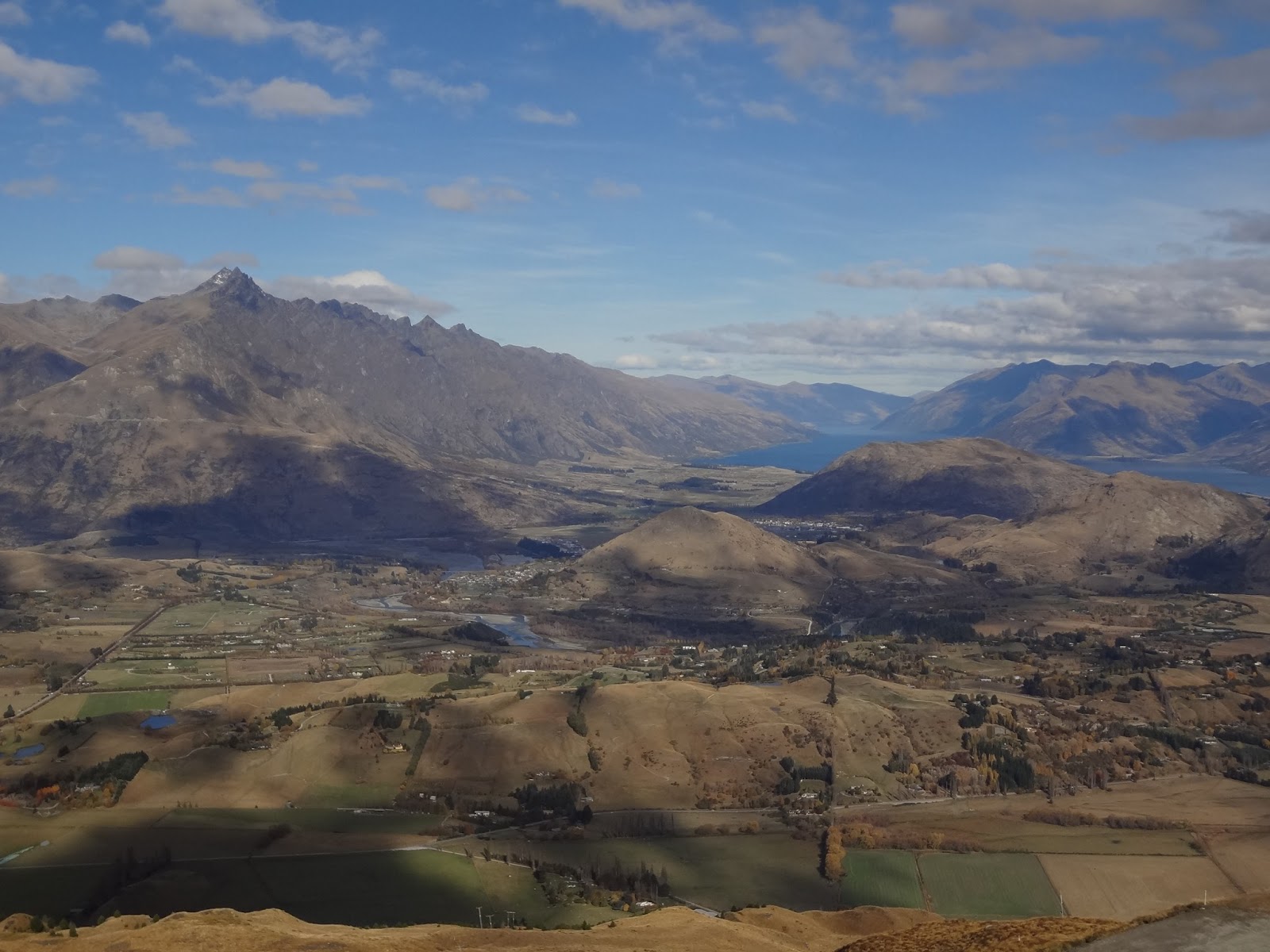
Cruising back through Queenstown, we made a vertical detour. Up, up, up, 1191 m by the GPS – I'd count on it being the highest I've ever been in a car, to the base of the Coronet Peak ski field. The lifts climb an additional 500 m, and right now people might be mountain biking and paragliding from these heights, but it won't be long before the snowguns get fired to life and the skiers start lining up. Up here, you've got a panoramic view of the sprawling valley, from Queenstown to Arrowtown and the Crown Ranges, on as far to the bottom of Lake Wakatipu and Kingston. Coronet Peak is one of three ski fields in the immediate area – the Remarkables looks across the Wakatipu Basin, and the Cardrona Alpine Resort is en route to Wanaka. I wonder where in this country I'll be, once the snow settles in?


Heading back down to the valley, we skirted the gravel road heading on to Skippers Canyon, just over the back hills. Remnants from the gold era are hidden along this off-road passage along the Shotover Valley where rental cars aren't allowed.
 

By now, it was high time for fish and chips and pints at the Tap.

Sunday morning, the weather ended up coming down in buckets, like they said. I met up with Rory for a breakfast coffee in Arrowtown, getting pointed in the direction of Ray Wade's Studio. A local self-taught jeweller, Ray invited me in for a tea and jam-filled Kisses (straight from the Edmonds Cookery Book, a Kiwi staple that happens to be the biggest selling book in this country), showing me how he does some of his woodcuts, polishes his gems, and identifying the pounamu around my neck as Inanga, the Maori word for tiny Whitebait fish. Lamb roast garnished with pumpkin, kumara, and parsnip for dinner – another Kiwi staple.

The day was overcast but decent on Monday morning, so I decided to take a look down the road to Central Otago (take everything I say with a grain of salt – it was less than a week ago that I said I didn't have time to check out these parts). I hitched a ride with a local couple as far as the Arrow Junction, where the country road joins into Highway 6, and a Chinese couple on a whirlwind, two week tour of New Zealand's South Island, brought me to Cromwell, via a dangerously winding, narrow stretch of road along the Kawarau River. As if to reinforce that this country of sepia hillsides demands your attention, we passed a “Slow Down, High Crash Rate” sign – remember this bit of trivia, and place it on your mental map of the area, because it will be important.

Cozy Cromwell, positioned right where the Kawarau meets the Clutha coming down from the north, was once called the Junction because of this moist meeting place, and it was the gold that brought people here back in the 1860s. Nowadays, it's a fruitbowl hotspot, with wineries and orchards dotting the fields around Lake Dunstan, a man-made lake that flanks the town and originally grew as a result of the Clyde Dam in the 1990s (before that, the lake was a deep gorge with train tracks and a river some 40 m below the current level).
 

Much of the old town was destroyed and replaced by a modern development, but a little chunk along Melmore Terrace was reconstructed by Old Cromwell Incorporated.


The leaves are falling, littering the ground beneath bare and withered grapevines in front of mountains with a nice white toupee. It looks a lot different from when I arrived in Marlborough at the end of January.


A Kiwi from Queenstown who manages a sawmill in Alexandra picked me up along Highway 8, making a detour through Clyde to show me the imposing dam that churns out a heap of electricity for the national grid. We get talking, like you would, about what I'm doing down here. “You ever work in a timber yard before?”


I had to do a bit of a double take at my person. Jeans with factory rips about the knees, clean fingernails, and if you listened carefully you could probably hear Katy Perry coming through on the headphones in my backpack. Instead of saying, “What do you think?” I just said, “No.”

Well, you don't really need it,” he said, giving me his cell phone number and offering me a job that's literally better paid than anything a university degree and months of frustrating job hunting ever turned up. Who knows – I could end up back here soon enough. Or not. This whole thing is a tiki tour after all, not just the past few days but the whole kit and caboodle, and whatever happens happens.

When I ended up in Alexandra, it was just past 2:00. This spot is a bit bigger than the other stops along the road these past few days, with all the bells and whistles like box stores and a clockface in the hillside. Still, there's a historic core here – a bridge over the Clutha runs right next to crumbling piers from the old one from the 1800s, and there's the Otago Central Rail Trail.


At 150 km long, the walking/biking/horse riding track is the longest such trip in New Zealand, following the path that the Otago Central Railway ran between Middlemarch and Clyde from the 1920s until 1990. A little strip, about 8 km, passes between Alexandra and Clyde. I didn't have a bike, but for that short distance and with the sun still a ways over the horizon, I decided to walk it. The terrain wasn't the most invigorating in the world, but the flat gravel road looked upon plenty of mountainsides and isolated little farms. Nothing wrong with a little stroll along the rail bed – I felt like I should have had a bamboo fishing rod slunk over my shoulder, on my way to the creek with at least one friend wearing overalls.


When I came to Clyde, a woman gave me a lift to the top of the hill just outside of town, where I caught a ride with a few Chinese tourists in a campervan. Things were going along smoothly, and when we came to the lookout before Cromwell and pulled over, I assumed the cameras were about to go nuts.
 

Sure, we got a few pictures. But the main reason for stopping was because of the police with his sirens flashing.

Even the police in this country are friendly. The Kiwi cop seemed to legitimately felt bad for pulling these people over, even though other drivers had been calling to complain about their driving all afternoon. Actually, scratch that – they'd been complaining for days, from Milford to Dunedin.

In the short distance since I'd joined them, I hadn't noticed anything erratic, which is probably why I didn't jump out right then and there. But I watched, knuckles whitening, as he tried to explain how you don't overtake if you can't see ahead of you and how you need to slow down going through towns (“50 kilometres . . . that's five zero. Five. Zero.”). I could see the heads nodding just as clearly as I could see the language barrier and the words bouncing haphazardly in all directions.

“Oh, how are ya mate?” he said when he saw me in the backseat, and I could see the relief flood into him upon seeing a native speaker. I followed him when he went back to his car to write the ticket.

“So, umm, is it legal for me to drive the rest of the way?”

He thought for a minute. “It would be a lot safer,” he said, “but if you got into an accident, you're not insured.”

So we came up with a compromise – I sat in the front seat and kept an eye on things. Like speed, and telling her to pull over because her headlights clearly weren't on and the last thing I wanted was her fumbling with switches and levers as we drove down the highway. The same highway (remember?) with a high rate of crashes.

Now that you're sufficiently worried about my well-being, let me say that after that fiasco, the drive back was much safer. The middle-aged woman taking driving lessons from a snot-nosed Canadian kid had gotten an overly polite dose of the fear of God put in her, and every passing lane saw a slew of cars whisk past us. Just as dusk was settling in, we made it back to Arrowtown – in one piece and everything.
 

This morning is bright and sunny, but there was even more snow overnight – the mountains have a full blanket of snow, not just a skirmish. The same mountains that, if all goes according to plan, I'll be heading over this evening, to make my way north to Wanaka for a few nights, to see the other side and keep moving. Until I go and buy a winter coat (I threw out a pair of shorts during this stay), that's the only guaranteed way to keep from freezing.

Cheers,
rb

Friday, May 03, 2013

Looking Over The Edge: A True Story of Bungy Jumping

When I was nine years old, my family went to Disneyworld. My brother, ever the hellbent yin to a stoic yang, especially at seven, decided that he wanted to go on the Twilight Zone Tower of Terror ride, a 13 storey elevator drop in a creepy old hotel. He probably had to stuff his sneakers with tissues to meet the height requirement. The queue for the ride was immense, even by Disney standards, the lineup winding through a dilapidated lobby and corridors while your anticipation built – or, in my case, my resolve that I should have just gone on the It's a Small World boat trip instead. When we finally made it to the front of the lineup and the ghastly bellhop raised a crooked finger to beckon us on – well, take a guess as to what happened.

I cried. That's what happened, and after waiting in the lineup for an hour and a half, maybe longer, I didn't get on the ride. I don't remember how I got out, but I assume that I was escorted out by some guy who didn't realize working in the happiest place on earth meant he'd have to put up with this crap.

That was in 1999. Since then, I've grown up. When I stood on the tiny threshold of the Nevis Bungy, bound in a harness and shackled at my ankles to a giant cord, looking down at the open gorge beneath me, I dealt with that sudden fear in a much more sophisticated, adult way. I think it went something like this:

"3 . . ."

Jesus Christ. Alright, I'm ready for this to be over now. If there's a merciful God somewhere, anywhere . . .


"2 . . ."

. . . then please, PLEASE, all I'm asking . . .


"1 . . ."

. . . is to just strike me dead, right here right now. Because there's no way I'm going to . . .


"Go!"


Woah woah woah – hold the phone, make that record scratch noise and pause in midair. My nerves are still fried, I can't just dive into that part of the story again right away. Back up to the night before.

I had a conflict on Thursday night. I had to get up around 8:00 the next morning, and the last thing I wanted was to dive headfirst down a canyon with a hangover. On the other hand, I was starting to get really nervous and kind of needed a drink. I fell in with a Scottish guy, Dave, who heard about a contest to win a free bungy at the hostel's Altitude bar, so after a lazy, damp Queenstown afternoon of tea and sushi, we headed down.

The bar was a lot more lively than the night before, what with a crowd from the Kiwi Experience bus tour stopping in town. We had a few drinks, and Dave managed to find a girl from Missouri and form one of only half a dozen teams of two allowed in the competition. The A.J. Hackett guys were running the contest, where one team member was strapped into a bungy and had to run down the length of the bar, grab a pre-poured drink, and bring it back for their partner to chug. The fastest time in the horizontal bungy wins, the main difficulty being a little thing known as tension.

Oh, and because this is party town, teams got time taken off depending on how much clothes they took off. Dave won his bungy and a girl showed her boobs, both of which were pretty groovy and something that only happens in an American Pie spinoff sequel. Speaking of things that only happen in movies, did you know that Coyote Ugly-style dancing on bartops also happens in real life? It only looks like my morals are debauched and hell bound – I was under a lot of pressure, remember?

Let the final judgement begin. I was awake before my alarm went off, grabbed a breakfast I thought I might end up throwing up, peed about seventeen times, and walked down the street to the bungy dispatch office. The first thing they do is empty your pockets and weigh you (twice, because close only counts in horseshoes and hand grenades), and mark your jump number on your hand. Then, it's onto a bus, driving outside of Queenstown, first to the Kawarau River Bridge, 47 m and the world's first bungy. After a short drop-off, it's another twenty minutes, up a dirt road and onto farmland, to the gorge cut by the Nevis River.


Up a hill we climb, and the platform comes into view. It's not just a little building on the edge of a sheer cliff – it's a little building held on tight cables in the middle of the valley. The first thing we had to do was slip our legs through a harness, a jumble of cords and clips that all presumably do something life-saving. Try to stand on one foot and guide the other through a harness loop. Jaysus. Once all the straps were tightened, we were weighed again, and that number got scrawled on the other hand.

For the debrief, there were only two guidelines: the first was to spread your arms and jump headfirst. The second was to pull a release on your foot after the first two bounces of the bungy cord, so that you could sit up and be more comfortable rather than inverted and feeling the blood rush to the same head that's frantically trying to figure out why you're still alive after pulling that ridiculously stupid stunt. With that, it was into the brisk morning air, strapped into a little box guided by a pulley to the jump station that felt like it was miles away. And of course there would only be a grate floor, so that you could have a scenic view in all directions as you went over to the point of no return.


I won't say that I wasn't nervous, because I was scared out of my wits. But I wasn't as scared out of my wits as I thought I was supposed to be. Actually, I was pretty stoked to be out in the open air in the middle of the gorge, ready to leap – interrupted every so often by a lurch of the stomach when I saw someone else jump.


The enclosed, suspended platform was a squat spot that could only hold about two dozen people. A waiting area lined the sides, while the front wall was missing, save for a tiny metal platform big enough for two feet. Two bungy guides were busy in here, gearing up a jumper by attaching the heavy bungy to loops on the feet, bringing them to the edge, and working all the switches and levers to bring them back to solid ground again in one piece. The tiny cart that connected the platform to the hillside was always moving too, bringing people back and forth and keeping everything moving pretty quickly.

I don't know how to describe the atmosphere in that little room, but let me try. It was the bated breath of anticipation fuelled by adrenaline and terror. Not terror for life or safety (I don't think it ever crossed my mind that something would go wrong), but rather terror for a bodily sensation that is overwhelming in its sudden novelty. If you haven't bungy jumped before, then no other experience is even remotely similar to this one, and you know that and know how it works but have no idea how you're going to handle it.


There's not much worse than waiting, after one jumper comes back up, to see if you're going to be next or if you're going to have another few minutes of grace. The only thing worse, in fact, comes after you've been called, after getting the bungy attached to your feet (and having small talk with the executioner kind employee, kind of like when your dentist asks you about school while drilling into your mouth), and after you shuffle over to the platform that sticks out into the sky. That's where you realize that, sure enough, you're going to have to do this. Now.


3 . . . 2 . . . 1 . . .


I really was able to hold my hand out a few moments before getting called forward and keep it still. I really did get to the ledge and have a stirring feeling in the pit of my stomach that there really was no way I was going to back to do this. I'd be relatively fine once I started the fall, but how could I possibly make that leap? Go from safety into the nothingness just past the open door. It was the truest fear I think I've ever experienced, and maybe that's why you only have a few seconds in this position, so that the enormity of the situation never really sets in.

Somehow, I just did it. I didn't realize a guy could scream and bawl out that loud.


The fall was unlike anything else. The world shoots past you faster than I would have ever imagined, a jumble of colours and blurs and headrush. The first second was the worst, a sudden feeling of being completely detached. And that makes sense – when else are you suspended in midair like this? I don't like admitting defeat, but words on a page can't adequately summon up what this experience was. Let's just say that it was, all at once, a stark realization of mortality, and a belief in absolute immortality.


Down in 8.5 seconds, bounce, a smaller descent and bounce, trying to get my bearings long enough to pull the foot cord and sit upright. It must have only taken two minutes before they were dropping a counterweight to pull me back to the loading dock, but it felt like time outside of time in a way that I've never felt before or even believed possible. The video they give you (well, sell at ridiculous markup, but you need your proof) is a good reminder, but the jump that I did wasn't a visual experience – it was every sense and maybe even a few other that you don't think about, and so watching it is something altogether different from doing it.

When I got back to Queenstown, I treated myself to a Fergburger, a signature meal in the city – the restaurant was packed to the rafters, which I'll take to be a good sign. I picked up a Sweet Bambi – wild Fiordland deer, lettuce, Thai plum chutney, red onion, and aioli. What part of the deer did they use? I think all of it, judging by the size of this thing. The side of fries was a bad idea.


Sufficiently full on venison and adrenaline, I unexpectedly ran into Rory from Invercargill before I met up with Alan from Arrowtown, my Queenstown tiki tour guide who offered me a bed back here for a few nights. There's snow in the forecast, but hopefully we'll get out for another look around over the weekend, to see a few more sights in the area before I head over the Crown Ranges to Wanaka.

First thing though, I want a solid sleep tonight, reassuring myself every so often that, when I put my feet down, there's solid ground beneath them. I don't want to go and do it again right away, but I will always have the awareness that I am capable of jumping off the edge. From here on, no matter what happens, there will never come a time that I didn't do this. And that's obvious, but it still only really makes sense now that I've actually done it and felt it myself.


I love it when things like that happen.

Cheers,
rb

Thursday, May 02, 2013

Fear and New Things in Queenstown

I remember setting a goal, early on, to try something totally new as often as I could. That's probably why I ended up with the deer the other day, and definitely how I ended up here today.

Graeme's buddy Ian is like a character from the outback: dirty flannel shirt, weathered, wide-brim hat peppered with feathers, and plenty of loud stories about the animals he's hunted. On his land, there are pigs and deer and sheep, but it's his father-in-law that has the real farm. Paddocks and paddocks of deer, and a bunch of them had to be tagged and given an inoculation to help with worms and all kinds of gross stuff in the stomach.

Through the jigs and the reels, I got asked to come lend a hand. What that entails is getting in the pan of a truck driving across some 600 acres nestled in the shadows of the Remarkables and forming a line with a couple of other guys to herd 60 deer (mostly females, the hinds, but a few male stags as well) from one paddock to the barn at the other end of the farm. It doesn't take much to make the deer skittish, so all you have to do is get behind them and start walking – if they change their mind and start coming back, even holding up a stick is enough to make them reconsider that.


It took about half an hour of opening and closing gates to bring them to the field next to the barn (a bit longer than usual, since these lot were relatively young and untrained). They couldn't all go in at the same time, but the operation ran like clockwork: one guy moved the herd to one end of the field (have you ever seen 60 deer gallop past you in a line in the autumn sun? You should), another guy was waiting to move them back, and a truck (with a yelping guy in the back, waving a stick) was parked in the middle, to drive forward and break up the line so that a manageable number could be brought into the barn, which was a maze of walls and gates to separate the deer.


Again, something like clockwork, bringing a few deer into a tiny enclosure, where the stags got a hose down their throats for a squirt of medicine and every deer had something like a rivet gun squeezed on their ear to apply a little circular electronic tag. Some deer weren't fussy, but others kicked up a real stink – literally on the kicking part, figuratively on the stinking part.

At the end, they were brought to another open field, relieved to be let loose. It's a side of the industry you aren't usually privy to, but as cool as it was, it wasn't all pretty – while being herded, it wasn't uncommon for one of these otherwise graceful creatures to try to escape over the wire fence and thrash their bodies around painfully, and while waiting to be tagged there were more than a few that were shaking out of absolute terror. And of course, there's the fact that the deer aren't being tagged so that the farmer can keep track of where Bambi is out grazing – it's if the meat has to be traced back to the farm after the deer has been slaughtered.

If you're going to be a carnivore, however, that's a fact of life. At least they get to spend what life they have in the open fields outside of Arrowtown.


The first frost of the year decorated the lawn yesterday, and it was cold on into the mid-morning. The trip to Glenorchy didn't happen after all because of a medical appointment (not mine, I'm still healthy as a horse), but I still headed to Queenstown, to pitch for a few nights in the bustling epicentre of New Zealand fun.


Remember Base, from way back in Auckland? That feels like a long way away now. Anyway, that's where I ended up, back in a dorm room of backpackers. I've totally noticed a change though – a few months ago, the exploits of these kinds of strangers were intimidating and otherworldly. Now, it's a lot easier to relate.

Like the German girl who hitchhiked to Queenstown from Milford yesterday. Before, I might have said something like, “You went into the middle of nowhere on your own, with no ride? Are you insane?” Now, it was something more like, “Cool, did you have a hard time finding a ride? Because when I did that same thing last week . . .”


I had the full day to explore Queenstown, which is surprisingly easy to do on foot, since it's so compact. First impressions were pretty much exactly what I thought they'd be: a menagerie of restaurants, bars, sports apparel stores, and booking agencies for bungy jumps, paragliding, boat cruises, and any other extreme sport that a Kiwi mind can concoct. Queenstown is, first and foremost, a business – it's fun (maybe too much fun), but it costs.


That's just the downtown cluster though – outside of that, you're on the shores of the lake and in the cradle of the mountains. It's a pretty special place, and though I wouldn't be able to keep up with the bustling, border-pushing lifestyle for too long (I've met a bunch of people who plan to spend most of their year abroad here – I'd think the party hardy atmosphere would get exhausting when that's all there is, but what do I know?), I'm glad I get a few days here to soak it all in.


Along the Queenstown Gardens, a forested finger of land sticking out into the lake, there's a nice walk for a chilly morning, but also a golf course – a disc golf course. Ever hear tell of it? Me neither, but orthodox is the last thing to stand in the way of someone from Queenstown. Take a Frisbee, start at a number tee, and aim for a chained basket further along the path. And it's a legitimate thing: this is a permanent marked course (New Zealand's first) with scorecards and everything. I checked that out and had a few pieces of homemade fudge for lunch (hokey pokey fudge is totally a thing, praise these Kiwis), not consciously trying to be quirky, just trying to fit in.


The Queenstown Hill is a grassy knob with a view. 360 degrees of views, in fact, from Lake Wakatipu to the Remarkables to rows and rows of mountain heights trudging on into the distance, wrapped around the Basket of Dreams, a sculpture to mark the millennium. People came to Queenstown for the gold 150 years ago, but it couldn't have taken too long before the early residents got sick of all work and no play and decided to have fun in this awesome playground here at the bottom of the earth.


After settling in and having some noodles for supper (back to that song and dance for a few more days), I was at a bit of a loss. Wednesday night in party city – what to do? The reputation of this city is something I've been very, very aware of, long before I even left Newfoundland. And it's like I said earlier – I wouldn't be able to do it for a long chunk of time, but when you're only spending a few nights in Queenstown, you might as well do it right and hit the town. Hard.

I managed to fall in with a group from the hostel who were going to Cowboys, a Western-themed spot with a mechanical bull, a paua-decorated shuffle board table, and giant mugs of beer. I'm not bad at shuffle board, it turns out, and when a group of strangers you don't want to irk have only ten minutes to get to the next bar and you have a full mug of beer . . . well, it turns out I'm not terrible at getting rid of that in a hurry. There's a right and wrong way to do Queenstown, and sometimes which one is which isn't what you'd expect.

Altitude, the hostel bar, was dead, so the bar hopping continued on to Searle Lane, a bar of polished wood and pool tables. I suppose we could have ended up at a thumping dance club for some more life, but that ended up being the cap off to the night, a bit of fun that didn't end up with too heavy a head this morning.

Do something different every chance you get – a caveat of that goal is to do something that scares you every chance you get. There's a guy who volunteers at the summer camp where I used to work named Art. Art is the closest thing I've ever met to a crazy old man – a born again fundamentalist who used to be a heavy drinker and a street fighter. I've never asked Art if he's ever killed anyone, maybe because I'm legitimately afraid of the answer. Anyway, I like Art. I remember, vividly, the day a kid's Frisbee got stuck on the roof of the bunkhouse, and it came to the dynamic duo of Art and me to get it down. No need to bother with the ladder – it's up on Art's shoulders. And as I stood there on the wobbly human stepladder, barely clinging to the rooftop and slowly getting raised up to that weird limbo point where you can't turn back but you're not really sure how to get any further, I turned and called back down, “Art . . . I just realized I'm afraid of heights.”

Fast forward to today. Bungy jumping is a Kiwi sport, one of these things that you just have to do, especially in the adrenaline capital of Queenstown where A.J. Hackett perfected the idea. The Nevis Bungy isn't the highest in the world, but it is the highest Down Under – and I really mean it when I say that 134 m seemed like nothing back home. Somehow, over the course of a few months, that height has been enlarged an absurd amount. The highest building back home is less than half of that height. The human body has a response system that says to not jump off of something that big. And yet, tomorrow morning, that's precisely what I'm doing.

I've heard from people who have gone skydiving that they would be afraid to bungy, because of the fact that the airplane height doesn't seem real, whereas with the bungy jump, you're at the kind of height that you can vividly imagine the fall. From a comfortable couch, I've tried to imagine that height, and tried to imagine free falling from it. It makes me a bit sick, and I think that the five seconds where they count “5 . . . 4 . . . 3 . . . 2 . . . 1 . . .” might well be the worst five seconds of my life – at least at the time. I sure hope, springing back up, that I'll realize it was the five seconds that led up to the biggest thrill of my life.

Multiple people have told me to be careful when it comes to the bungy jump. I appreciate that concern, but literally the only responsibility I've got is to jump off a 134 m platform. I'm not sure what the difference is between doing that safely and doing that unsafely. I'll make sure they have the elastic tied around my ankles at least.

Assuming I land everything alright, it's hopefully on to Glenorchy after all this weekend, and then up to Wanaka. When I made a tentative roadmap plan at the beginning of April, I pencilled in Wellington for mid-May. That's still two weeks away, but it's not looking likely, with more than a few planned stops in between – for the first time the other day, I ruled something out (spending time exploring Central Otago) for a good reason, but it still shocked me as soon as I heard the words tumble out of my mouth: “I don't have time.”

It's impossible to do everything, and I knew it from the day I stepped on that plane in Deer Lake, but I'm still realizing it – just make sure that the things that you do do are worth remembering, rather than regretting all the rest. That's another goal of mine.

Cheers,
rb